When you think about website speed, you probably think about things like optimized images or powerful hosting. But there’s a huge factor that many people overlook: physical distance. The speed of light is fast, but the time it takes for data to travel across oceans and continents is not zero.
This delay, known as latency, can be the silent killer of your website’s performance.
So how do you solve the problem of distance? The answer is one of the most powerful and essential tools for any modern website: a Content Delivery Network (CDN).
At HimariDT, we’ll explain what a CDN is using a simple analogy, how it works its magic, and why it’s a non-negotiable tool for any serious website in 2025.
What is a CDN?
Imagine your website is a single, amazing coffee shop located in Dallas, Texas. Your coffee (your website’s content) is the best in the world.
- Without a CDN: If a customer from your hometown of Ho Chi Minh City wants your coffee, they have to make the long, slow journey all the way to Dallas. The distance makes the delivery time terrible.
- With a CDN: You’ve become a global franchise. You’ve opened branches of your coffee shop all over the world, including a location right in Ho Chi Minh City. Now, when your local customer wants your coffee, they just go to the nearby branch. They get the exact same high-quality product, but the delivery is almost instant.
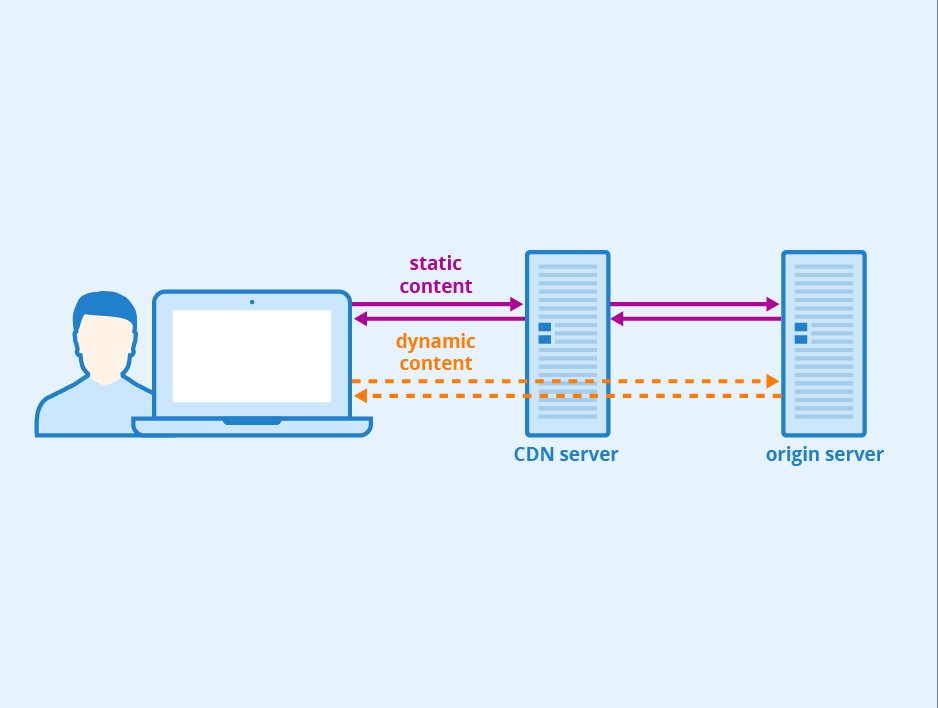
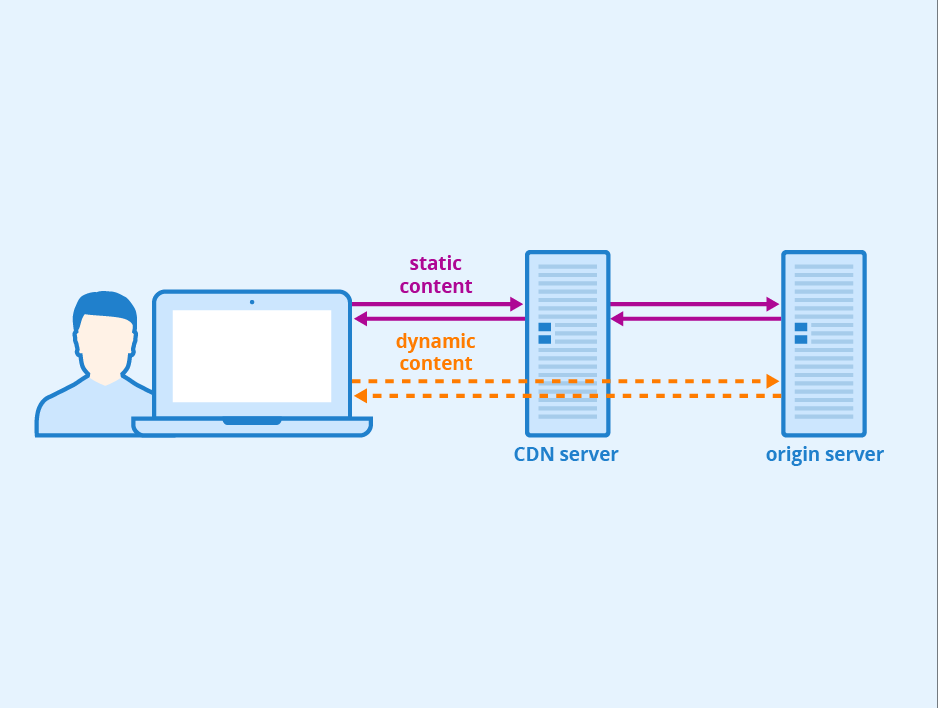
A CDN is that global network of franchises for your website. It’s a distributed network of servers strategically placed around the world. These servers store copies of your website’s static assets—the “heavy” parts like images, CSS files, and JavaScript.
- Your main web host is the Origin Server (the headquarters in Dallas).
- The CDN’s distributed servers are called Edge Servers or Points of Presence (PoPs) (the franchises in Ho Chi Minh City, Singapore, Tokyo, London, etc.).
How does CDN actually work?
Let’s continue our example. Your website is hosted on a server in Dallas, and you’ve just set up a CDN.
- A visitor from Ho Chi Minh City types your website address into their browser.
- Instead of the request traveling all the way to Dallas, the CDN intelligently routes it to the nearest Edge Server, which might be in Singapore.
- The Singapore server checks to see if it has the requested files (like your logo, stylesheets, and images).
- If it does, it serves those files directly to the visitor at incredible speed.
- If it doesn’t (for example, if this is the very first visitor from the region), the Edge Server quickly contacts your Origin Server in Dallas, downloads the files, saves a copy of them for the next visitor (this is called “caching”), and then serves them to your visitor.
The result? The heaviest parts of your website are delivered from a server that is thousands of kilometers closer, dramatically reducing latency and making your site feel incredibly fast.
Why does your website need CDN?
A CDN does more than just speed up your site. Modern CDNs are a powerhouse of performance, reliability, and security.
Blazing fast speed and performance
This is the main benefit. By reducing the physical distance data has to travel, a CDN drastically cuts down on loading times. This leads to a better user experience, lower bounce rates, and improved Google Core Web Vitals, which can directly boost your SEO rankings.
Increased reliability and uptime
A CDN distributes your website’s traffic load across many servers instead of concentrating it all on your single origin server.
- Traffic spikes: If your site suddenly goes viral, the CDN can absorb the traffic spike, preventing your main server from crashing.
- Origin server outages: If your main hosting server goes down for a few minutes, some CDNs can continue to serve the cached version of your site to visitors, keeping you online even during an outage.
Massive security boost
This is a huge, often overlooked benefit. A good CDN acts as a protective shield that sits in front of your website. Services like Cloudflare are renowned for their security features:
- DDoS mitigation: A Distributed Denial of Service (DDoS) attack tries to overwhelm your server with traffic. A CDN can absorb and block these massive attacks before they ever reach your host.
- Web application firewall (WAF): A WAF can automatically block malicious bots, SQL injection attempts, and other common hacking threats.
- Free SSL certificate: Most modern CDNs will provide a free SSL certificate, enabling the secure HTTPS connection (the padlock icon) for your site.
How to get started
Years ago, CDNs were expensive and complex. Today, they are accessible to everyone, and in many cases, they are free.
The most highly recommended CDN for most website owners is Cloudflare. Its free plan is incredibly generous and includes a world-class global CDN, DDoS protection, and a free SSL certificate.
Setting it up is surprisingly simple and requires no coding:
- Sign up for a free account on the Cloudflare website.
- Add your domain name. Cloudflare will automatically scan for your existing DNS records.
- The final step is the most important: Cloudflare will give you two new nameservers. You need to log in to your domain registrar (where you bought your domain, like Spaceship), find the DNS management section, and replace your current nameservers with the ones Cloudflare gave you.
That’s it. The change can take a few hours to propagate across the internet, but once it does, your website’s traffic will be routed through Cloudflare’s global network.
Conclusion
In our interconnected world, speed and security are not luxuries; they are necessities. A Content Delivery Network is one of the single most impactful upgrades you can make to your website, solving the fundamental problem of distance.
It will make your site faster for every visitor, more resilient to traffic spikes, and far more secure from common threats. With powerful and free options like Cloudflare available, there is simply no reason for any serious website to be without a CDN in 2025.