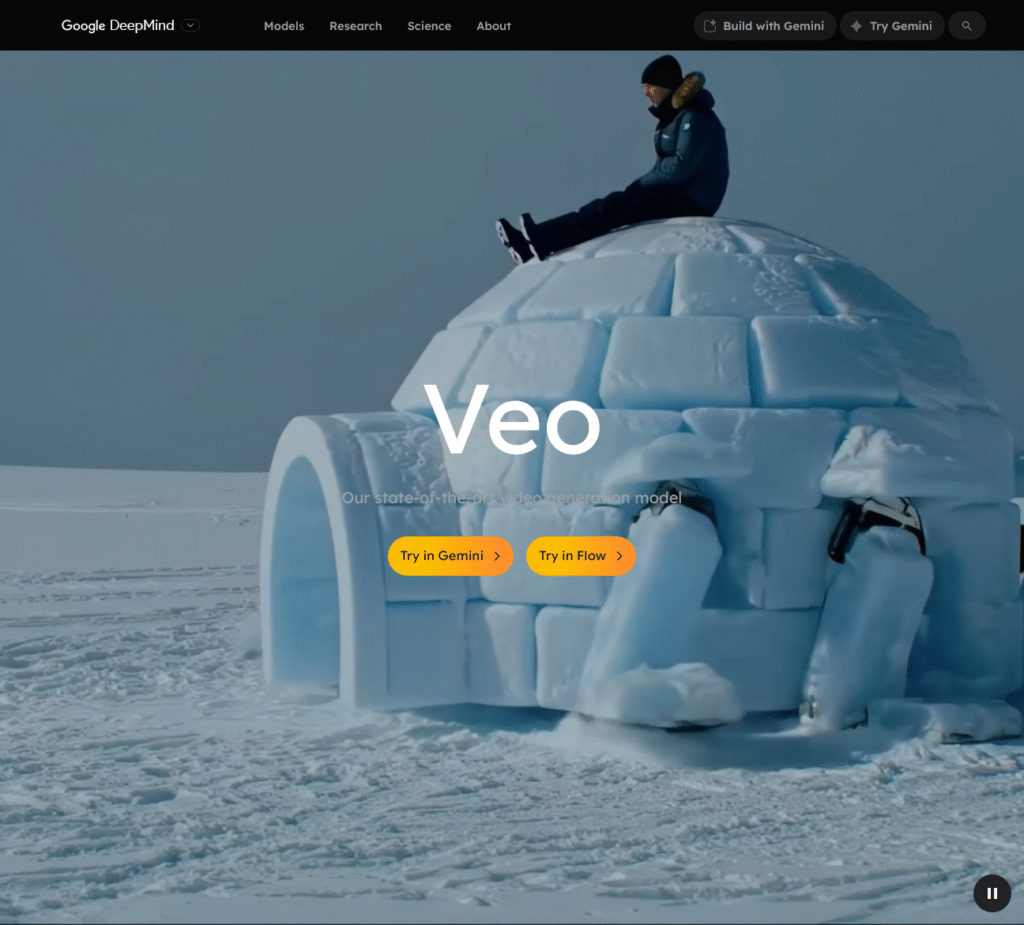
Over the past year, you’ve undoubtedly seen them: stunning, photorealistic videos flooding your social media feeds that were not filmed with a camera, but generated from a simple line of text. A majestic woolly mammoth trudging through a snowy landscape, a drone shot flying through a futuristic city, a dog vlogging from a tropical beach.
These creations, powered by groundbreaking models like Google’s Veo and OpenAI’s Sora, often feel like pure magic. But how does a machine actually translate the words “A cinematic shot of a coffee cup steaming on a rainy windowsill” into a moving, atmospheric video?
At HimariDT, we’re going to pull back the curtain on this revolutionary technology. We’ll explain the incredible challenges of generating video and break down how these AI models work in a way that anyone can understand.
The immense challenge of videos
First, we need to understand why creating video is exponentially harder for an AI than creating a still image. An AI image generator like Midjourney is a master painter; a video AI like Veo needs to be a master animator, physicist, and cinematographer all at once.
The primary challenges are:
- Temporal coherence (consistency over time): This is the biggest hurdle. If an AI generates a video frame by frame, it needs to ensure objects remain consistent. A person can’t suddenly change their shirt color, a car can’t vanish and reappear, and a shadow must move realistically with its object. Without this, the illusion is instantly broken.
- Understanding physics and motion: The AI needs an intuitive grasp of how the world works. It must understand gravity, momentum, and the properties of materials. How does water splash? How does fabric ripple in the wind? How does a ball bounce?
- Mastering cinematic language: The best models go a step further. They understand filmmaking concepts. A prompt that includes “drone shot”, “timelapse”, or “panning shot” should result in a video with that specific camera movement.
How do generative video AIs work
To explain this complex process, let’s use an analogy. Think of a generative video AI as a super-intelligent animator with a built-in physics engine.
The foundation
At their core, models like Veo are a type of diffusion model. They are trained on a massive dataset containing millions of high-quality videos and their corresponding text descriptions.
During this training, the AI learns a fascinating skill: it’s taught to take a clean video frame, progressively add random “noise” or static until the original image is unrecognizable, and then – crucially – it learns how to reverse the process. By learning to remove the noise and reconstruct the original video, the AI develops a deep, statistical understanding of what videos look like and how objects and scenes move and interact.
Understanding the prompt
When you give Veo a prompt like, “A photorealistic video of a sea turtle swimming through a coral reef”, the first step is language comprehension. The model uses a sophisticated language processing component (similar to the technology behind ChatGPT) to break down the key elements:
- Subject: Sea turtle
- Action: Swimming
- Environment: Coral reef
- Style: Photorealistic
Generating the video
This is where the magic happens. The AI doesn’t just create a single image. It thinks in terms of both space (the visual elements in a frame) and time (how those elements change across frames).
- It starts with a canvas of random noise.
- It begins the denoising process, gradually shaping the static into images that match the text prompt.
- Crucially, it uses a Spacetime Transformer architecture. You can think of this as a special ability that allows the model to look at multiple frames at the same time. As it generates Frame 5, it’s also looking at its plans for Frames 4 and 6 to ensure the movement of the turtle’s flipper is smooth and consistent.
- This process allows the AI to maintain temporal coherence. It “knows” that the turtle it’s creating must look the same and move realistically from one moment to the next, just as it learned from the millions of videos in its training data.
The result is a sequence of frames that are not only individually beautiful but also logically and physically connected over time, creating a coherent and believable video clip.
The future of generative videos
The implications of this technology are staggering and will touch nearly every creative industry.
- Filmmakers and advertisers: Can rapidly prototype scenes, create stunning visual effects, and storyboard entire projects without costly shoots.
- Educators and scientists: Can generate clear, animated visualizations of complex concepts, from historical events to cellular biology.
- Social media creators: Have a powerful new tool for creating unique, engaging, and imaginative content.
However, this power comes with significant ethical responsibilities. The potential for creating realistic deepfakes for misinformation is a serious concern. In response, companies like Google are actively developing tools like SynthID, which can add an invisible, permanent watermark to AI-generated content to help identify it as synthetic.
The misuse of AI generation
Like any powerful tool, generative video AI can be wielded for malicious purposes. The same technology that can create a beautiful piece of art can also be used to create convincing and dangerous fabrications.
The rise of hyper-realistic deepfakes
A “deepfake” is a synthetic video where a person’s likeness is digitally altered to look and sound like someone else. As AI video models become more realistic, they make it easier than ever to create deepfakes that are nearly indistinguishable from reality. This poses several serious threats:
- Political misinformation: Imagine a fake video of a world leader announcing a declaration of war, or a candidate admitting to a crime they never committed, released days before an election. The potential to manipulate public opinion and disrupt democratic processes is enormous.
- Personal harassment and scams: The technology can be used to create non-consensual explicit content, or to impersonate individuals for financial scams – for instance, a fake video call from a “family member” asking for emergency funds.
- The erosion of trust: Perhaps the greatest danger is the “liar’s dividend”. In a world where any video could be a fake, it becomes easier for malicious actors to dismiss real, factual video evidence of wrongdoing as a “deepfake”. This erodes the very foundation of shared reality.
Deceptive advertising and scams
Another area of abuse is in the creation of fraudulent advertisements. Scammers can leverage the public’s trust in well-known figures to promote their schemes. This can take the form of:
- Fake celebrity endorsements: A deepfake video of a trusted actor or public figure appearing to enthusiastically endorse a risky investment product, a dubious health supplement, or a fraudulent giveaway.
- Misleading product demonstrations: AI can generate videos of products working flawlessly or having features that they do not possess in reality.
The core problem is that this technology democratizes the ability to create high-quality, emotionally resonant disinformation at an unprecedented scale.
In response, the tech industry and governments are racing to develop countermeasures. This includes creating provenance tools like Google’s SynthID, which adds an invisible watermark to AI-generated content, as well as AI-powered detection models designed to spot fakes. However, it’s a constant cat-and-mouse game.
Conclusion
Generative video AI is not just a novelty; it represents a fundamental shift in digital creation. By learning the deep patterns of motion and visuals from vast datasets, these models are becoming powerful new paintbrushes for human imagination. They work by meticulously predicting how a scene should evolve over time, transforming a simple text prompt into a moving piece of art.
While the technology is still young, one thing is clear: the line between what is filmed and what is generated is blurring, opening up a new and exciting era for creators everywhere.