In the past few years, we’ve witnessed an explosion of generative AI that feels like science fiction. We’ve seen AI that can write articles, create stunning artwork from a text prompt, and now, a technology that can make a song sound as if it were sung by any artist, living or dead. One of the most prominent examples of this is RVC (Retrieval-based Voice Cloning).
But how does it actually work? It’s not magic – it’s a fascinating application of a core technology called Machine Learning (ML).
At HimariDT, we’re going to discover these concepts. First, we’ll cover the basics of how any machine “learns”. Then, we’ll take a deep dive into the clever process that allows RVC AI to clone a voice with stunning realism.
The basics
Before we get to voice cloning, we need to understand the fundamental concept of machine learning. Unlike traditional programming where humans write explicit, step-by-step rules for a computer, machine learning allows a computer to learn the rules for itself from data.
Let’s use a simple analogy: teaching a child to recognize animals.
- The data (the textbooks): You don’t write a rulebook for the child (“If it has pointy ears AND whiskers AND a long tail, it is a cat”). Instead, you show them thousands of pictures, each one labeled. “This is a picture of a cat”. “This is a dog”. “This is another cat”. This labeled collection of pictures is the training data.
- The model (the brain): As the child sees more examples, their brain starts to form a model – an internal concept of what constitutes a “cat” versus a “dog”. They begin to recognize the patterns and features associated with each animal (ear shape, snout length, body size).
- The training (the study process): The learning happens through trial and error. You show them a new picture and ask, “What is this?”, They make a prediction. If they’re right, their internal model is reinforced. If they’re wrong (“That’s a dog”, when it’s a wolf), you correct them. This feedback helps them adjust their internal model to be more accurate.
Machine learning works the same way. An algorithm (the model) is fed massive amounts of data, and it iteratively adjusts its internal mathematical parameters to get better at making predictions or identifying patterns.
How does AI clone a voice?
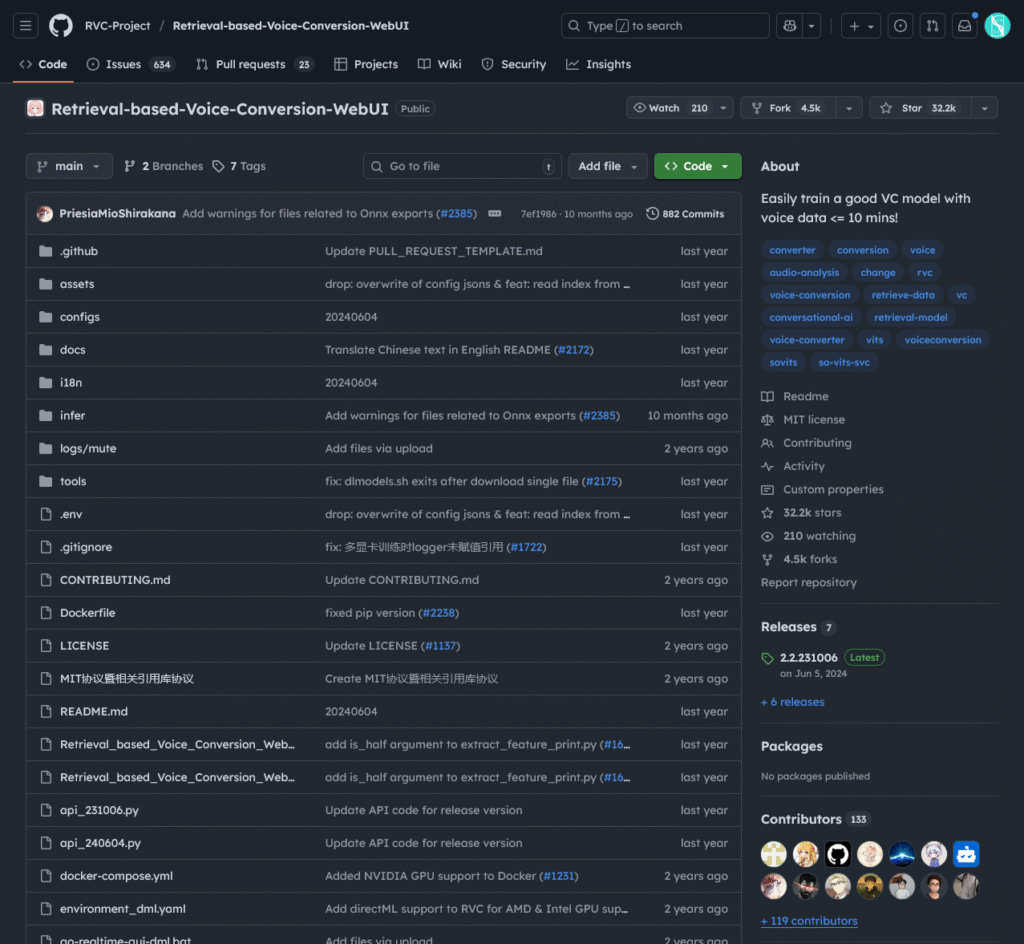
Now that we understand the basics of learning from data, let’s look at RVC. RVC is a powerful technique that can make one person’s voice sing or speak the words from another audio file.
The genius of RVC is its ability to separate what is being said (the content) from who is saying it (the voice timbre).
To understand this, let’s use another analogy: an incredibly talented impressionist musician.
The foundation
Before the musician can imitate anyone, they must first be an expert at music itself. A foundational AI model, often one called HuBERT, is pre-trained on tens of thousands of hours of speech from many different people.
Its goal is not to learn any specific voice, but to learn the fundamental components of human speech – phonemes, pitch, rhythm, and intonation. In our analogy, this is the musician learning to read any sheet of music and understand its melody and structure, regardless of the instrument playing it. This model becomes an expert on the “what”.
Training
This is where you, the user, come in. You provide the RVC model with a clean audio sample (usually a few minutes) of the target voice you want to clone. This is called the dataset.
The RVC model analyzes this audio sample and extracts its unique acoustic properties. This is the timbre – the texture, tone, and quality that makes a voice unique.
In our analogy, this is like giving the musician a 5-minute recording of a specific, rare Stradivarius violin. The musician listens intently, studying the violin’s unique resonance, warmth, and acoustic fingerprint. They are not learning a new song; they are learning the unique sound of that specific instrument. This is the “who”.
Conversion
Now for the final performance. You provide a new, clean audio file of someone singing or speaking. This is the source audio.
- The foundational model (HuBERT) first listens to your source audio and extracts its content – the “sheet music”. It understands the words, melody, and rhythm.
- Then, the RVC system takes this “sheet music” and tells the impressionist musician: “Play this, but make it sound exactly like that Stradivarius violin you just studied”.
- The model combines the content from the source audio with the timbre of the target voice. The “Retrieval” part of RVC’s name comes from the model “retrieving” the closest matching vocal characteristics from the training sample to apply to the new content.
The final output is a new audio file containing the words and melody from your source audio, but “performed” in the unique voice you trained.
What makes RVC so powerful?
RVC has become incredibly popular for a few key reasons:
- Low data requirement: Unlike older technologies that needed hours of studio-quality audio, RVC can produce impressive results with just a few minutes of clean training data.
- High-quality results: The retrieval-based method is very effective at capturing the nuances of a voice, leading to highly realistic outputs.
- Fast and accessible: Open-source projects have made RVC accessible to anyone with a reasonably powerful computer.
However, it’s not perfect. The quality of the output is heavily dependent on the quality of the input (a principle known as “garbage in, garbage out”). It can sometimes produce robotic artifacts, and most importantly, it comes with serious ethical considerations.
Voice cloning technology can be used for harmless fun, like creating song covers, but it can also be used for malicious purposes like creating deepfakes, scams, and misinformation. It is crucial to only use this technology legally and ethically, with the explicit consent of the person whose voice you are using.
Conclusion
Machine learning is fundamentally about teaching computers to find patterns in data. RVC is a brilliant example of this, using a clever two-step process to separate the content of speech from the unique sound of a voice. As this technology continues to evolve at a breathtaking pace, understanding how it works is the first step toward using it creatively, effectively, and responsibly.